
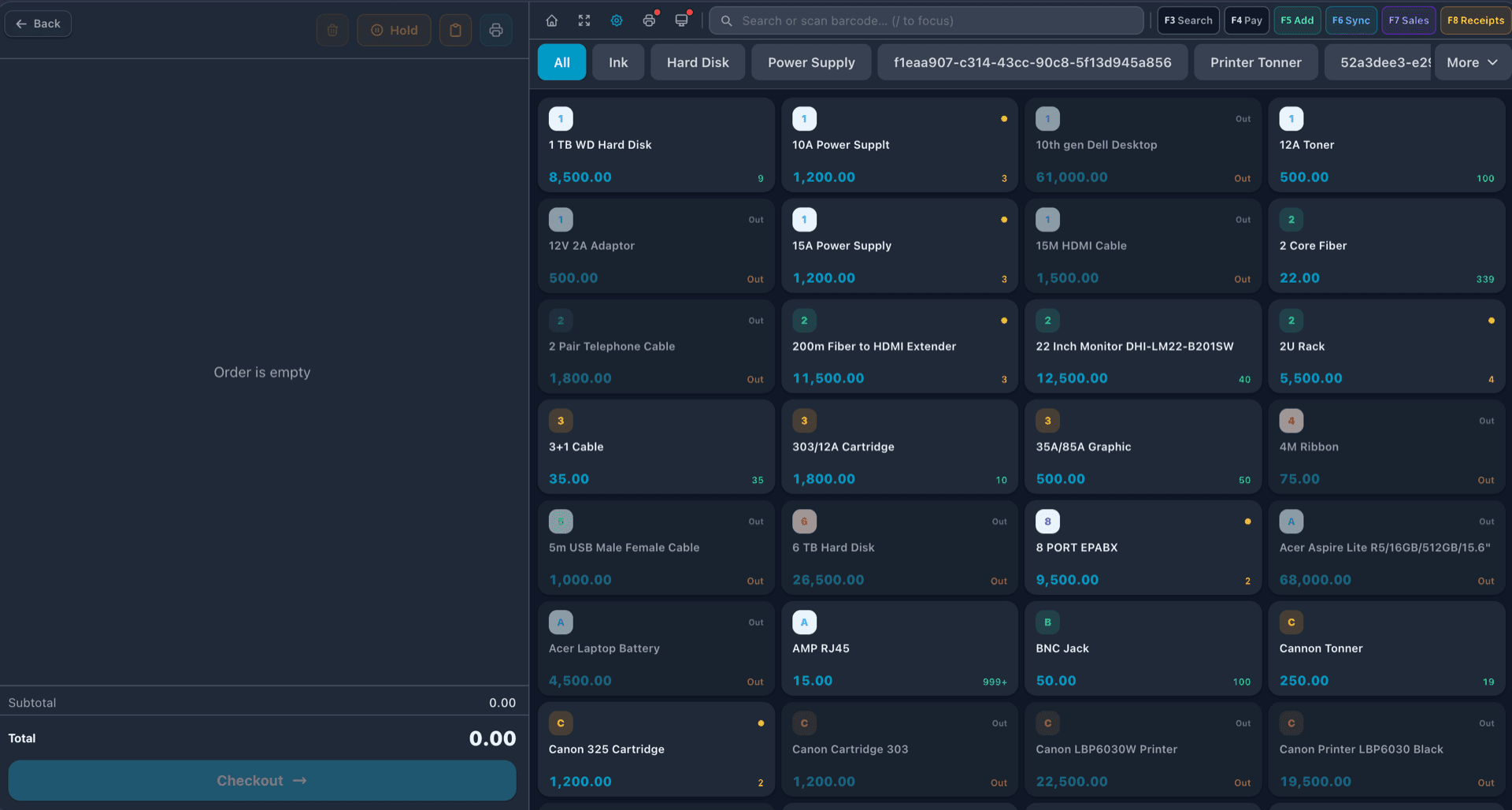
Retail & grocery
- Scan barcodes or search a large catalog
- Sell by case, pack, piece or weight
- Batches and expiry dates, earliest expiry first
- Cash, card, wallet/QR, split and pay-later
ScomsPOS · Cloud POS system
Checkout, inventory, tables, kitchen tickets and reports in one cloud POS — and it comes with your own ordering website, loyalty and marketing built in.
From $10/month · with online ordering $45/month + 4% platform fee per online order
Live demo of the real ScomsPOS screens — tap a table, add items, send to the kitchen, then check out.
Product tour
Real screens from the floor: reserve, move, merge and unmerge tables in a few taps.
Built for your business
Run a store, a restaurant, or both — ScomsPOS switches between a retail checkout and a full restaurant floor.
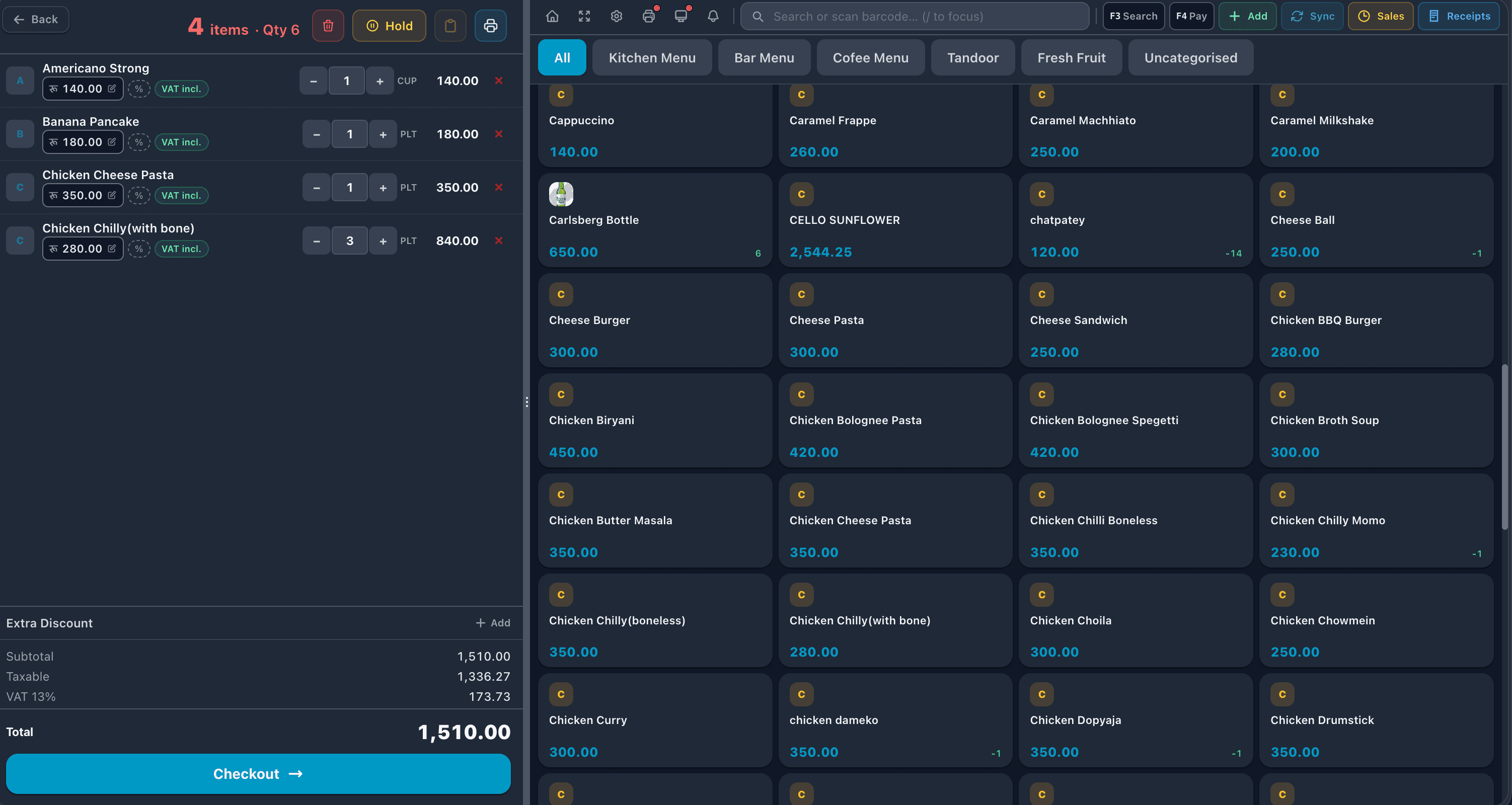
Built in. Ready to go.
No add-ons to buy and connect — it's all part of ScomsPOS.
Orders from your own ordering website arrive next to walk-in sales — with pickup time, delivery address and anything already paid.
Customers earn and spend points at the counter and online, and your store's gift cards work in both places.
If the internet drops, the app keeps taking sales and syncs them as soon as you're back online.
Every sale — in store or online — comes off the same inventory, with low-stock flags and reorder suggestions.
See today's sales, best sellers and payments by type, across every register and location.
Android tablets and phones or any browser, plus receipt and kitchen printers, scanners and cash drawers.
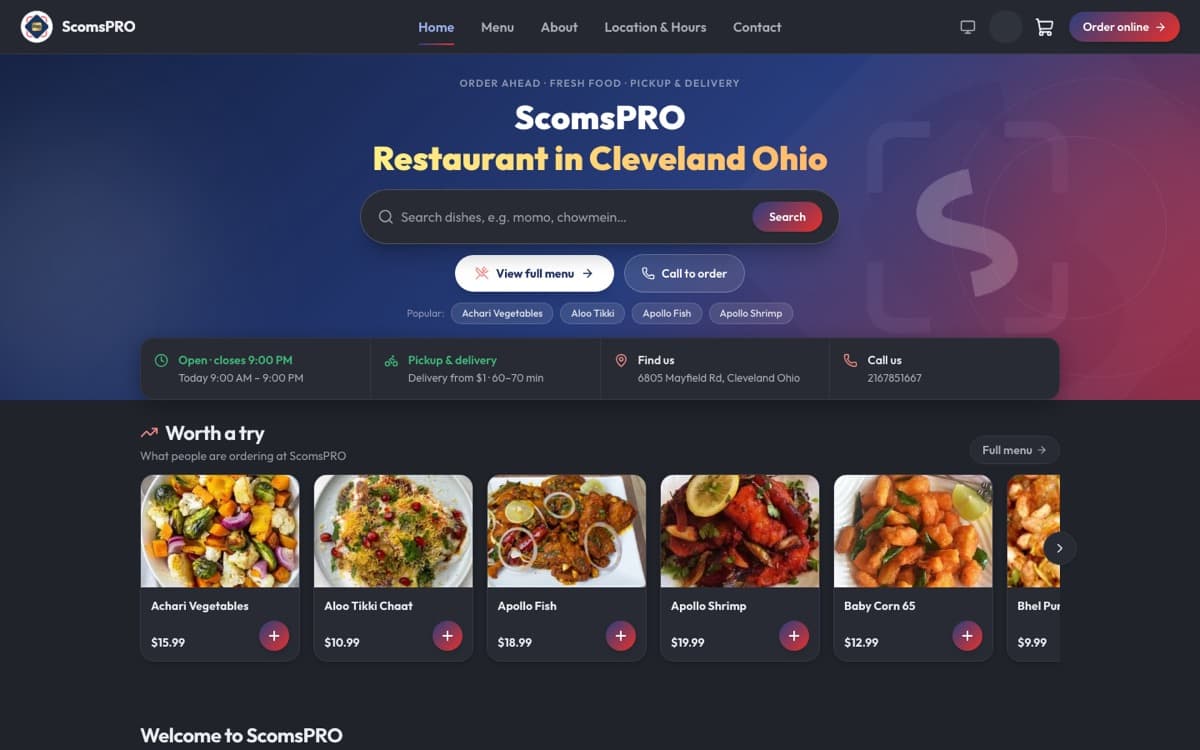
POS + your own website
Add your branded ordering website and orders flow straight to the counter — with loyalty, gift cards and SMS, email & push marketing to bring customers back.
No proprietary lock-in. Run ScomsPOS on the hardware you already have and connect the software that runs the rest of your business.
Run ScomsPOS on a modern dual-screen smart terminal — a 15.6″ FHD touchscreen for staff and a 10″ customer-facing display for totals, tips, and payment prompts — in a clean aluminum build with concealed cables. Prefer your own gear? The same software runs on any tablet, phone, laptop, or desktop.
Run your POS on a tablet, phone, laptop, or desktop. Add barcode scanners, receipt and kitchen printers, and cash drawers as you grow.
Every sale and stock update flows to the cloud instantly, so registers, dashboards, and the back office always show the same live numbers.
Connect payments, accounting, and eCommerce so sales, inventory, and revenue stay in sync across your whole stack.
Get started
We walk you through checkout, inventory and reports on your own kind of business.
Send us your menu or product list — we load it for you, free on every plan.
Sign in on the tablets, phones or computers you already have. No upfront hardware.
Tailored to your store count and the modules you need — no setup fees, no upfront hardware, and your first 3 months are free on every plan.
Every plan includes real-time cloud sync, free catalog & menu setup, and free demo onboarding.
Cloud POS, explained
A cloud POS system is point-of-sale software that keeps your sales, inventory and customer data in the cloud instead of on one machine. You can ring up sales, check stock and pull reports from any device, at any location, while updates and backups happen in the background.
ScomsPOS is a cloud POS for retail stores and restaurants across the USA — checkout, live inventory, customers and reports in one system, with every register working from the same numbers.
Where we serve
ScomsPOS is a cloud POS provider in Ohio, based near Cleveland, supporting retail and restaurant businesses from Greater Cleveland, Columbus, Cincinnati and Akron to every US state. There's no regional hardware to install — sign up, connect your locations and manage everything from one dashboard.
Questions owners ask
A cloud POS system is point-of-sale software that runs online and stores your sales, inventory, and customer data securely in the cloud instead of on a local server. You can access it from any device at any location, and it updates automatically. ScomsPOS is a cloud POS system built for retail stores and restaurants across the USA.
ScomsPOS supports retail stores, restaurants, cafes, bars, and multi-location enterprises. The same cloud POS platform unifies billing, inventory management, CRM, and analytics, with retail-specific and restaurant-specific tools built in.
Yes. Manage every branch from one dashboard with centralized inventory, real-time sync, consolidated reporting, and role-based access for staff across all of your locations.
Yes. ScomsPOS is fully cloud-based, so you can ring up sales, check inventory, and pull reports from any device at any location. Every transaction and stock update syncs in real time, and your data is backed up securely in the cloud automatically.
Yes. Real-time inventory management is built in — track stock across every location, get low-stock alerts, automate replenishment with reorder points, and manage suppliers and purchase orders from one place.
Yes. ScomsPOS is one platform for both. Retail businesses get catalog, barcode, and multi-store inventory tools; restaurants get table management, order flow, and kitchen-ready workflows — no separate systems required.
Yes. At the counter ScomsPOS records cash, card, wallet/QR, split and credit (pay later) payments, and online orders are paid by card through secure Stripe checkout. Every sale becomes a sales invoice that posts to your accounting, so sales, tax and revenue stay reconciled.
ScomsPOS starts at $10 per month: the Basic plan covers a single user and one register with inventory tracking for up to 500 items. The Standard plan is $20 per month and adds multi-user access, billing, CRM, multi-location management, and ScomsEats online ordering integration. Sell & grow is $45 per month plus a 4% platform fee per online order and adds your own branded online ordering website, SMS, email & app push marketing, and loyalty rewards. Larger operations get a tailored quote — book a free demo. There are no setup fees, and every plan starts with your first 3 months free.
Yes. Online card payments go through Stripe's secure checkout, so card details never touch your POS. Tax is calculated per item on every sale, staff get role-based access, and your data is kept in the cloud rather than on a single device.
Yes. With the Sell & grow plan your store gets its own branded ordering website, where customers order pickup or delivery and pay online. Orders appear on the POS's Online Orders screen next to walk-in sales, and loyalty points, gift cards and SMS, email & push marketing are included.
Yes. ScomsPOS is a cloud POS provider headquartered in Mayfield Heights, Ohio, near Cleveland. We work with retail stores and restaurants across Cleveland, Columbus, Cincinnati, and Akron — and because the platform is fully cloud-based, with businesses in every US state. Ohio businesses get local, US-based support and free in-person or online demos.
Book a free online or in-person demo. Our team walks you through checkout, inventory and reporting, sets up your catalog or menu for free, and helps you go live on the devices you already own — no upfront hardware required.
See how your own menu would look and sell on NEAPES. We'll show you the numbers, not a slideshow.
Ohio-based, cloud-delivered everywhere. Explore the POS system for your city:
Square, Toast, Clover, Shopify POS, and ScomsPOS compared on pricing models, hardware lock-in, and who each one actually fits.
Order lifecycle, modifiers, kitchen routing, and recipe-level inventory depletion — five structural differences, not cosmetic ones.
Central catalogues, tracked stock transfers, per-jurisdiction tax, and the reporting questions that only exist at scale.