
A $40 online order isn't worth $40 to you. Depending on how it came in and how it reaches the customer, it might be worth thirty, or closer to thirty-seven. That doesn't sound like much on one order. Over a few hundred orders a month, it's the difference between online ordering paying for a part-time cook and barely covering itself.
So let's put numbers on it.
One order, four ways
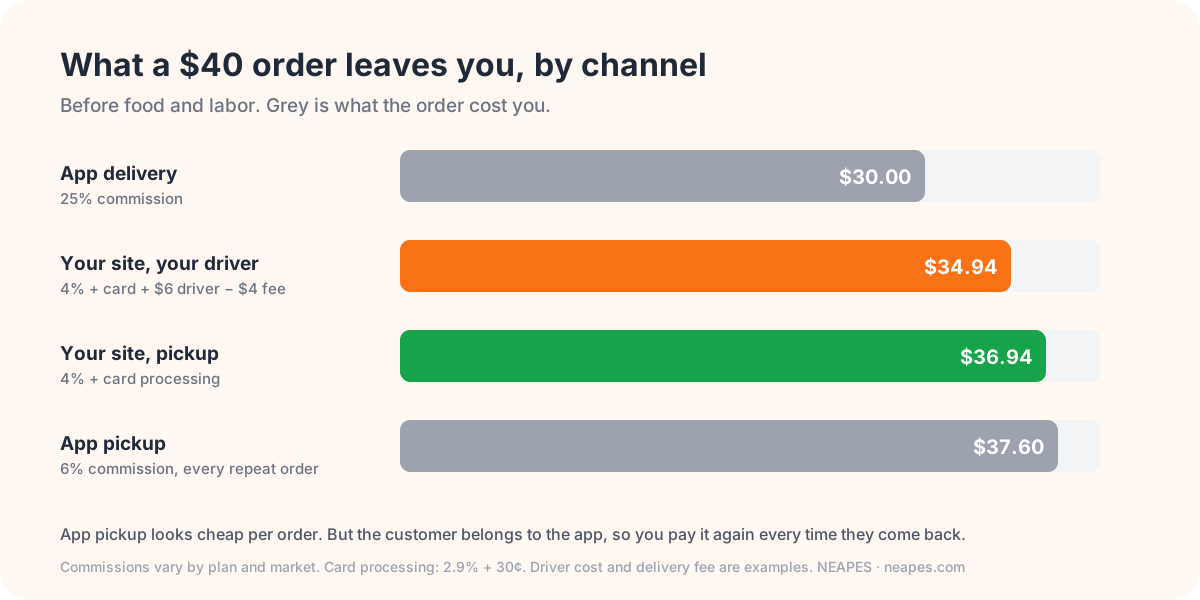
We'll take a $40 order through four channels. For the delivery apps we'll use a 25% commission on delivery and 6% on pickup, which is in line with what DoorDash publishes for its US plans. For your own website we'll use a 4% platform fee plus Stripe's standard card rate of 2.9% + 30¢. For your own delivery, say a driver costs you $6 a trip and you charge a $4 delivery fee. Those last two numbers are made up, so swap in your own.
| Channel | What it costs you | What you keep |
|---|---|---|
| App delivery (25% commission) | $10.00 | $30.00 |
| App pickup (6% commission) | $2.40 | $37.60 |
| Your site, your driver | $1.60 + $1.46 card + $6 driver − $4 delivery fee = $5.06 | $34.94 |
| Your site, pickup | $1.60 + $1.46 card = $3.06 | $36.94 |
Commission rates vary by plan and market, so check yours. The percentages are worked out on the $40 food total.
Hang on, app pickup comes out on top?
On a single order, yes. A 6% pickup commission is less than 4% plus card processing. But look at what you're getting for it. The customer ordered through the app, so their name, email and phone stay with the app. Next week, when they're hungry again, they'll open the app rather than your website, and they'll scroll past your competitors to get to you. Maybe. And you'll pay the commission again, and again the week after that.
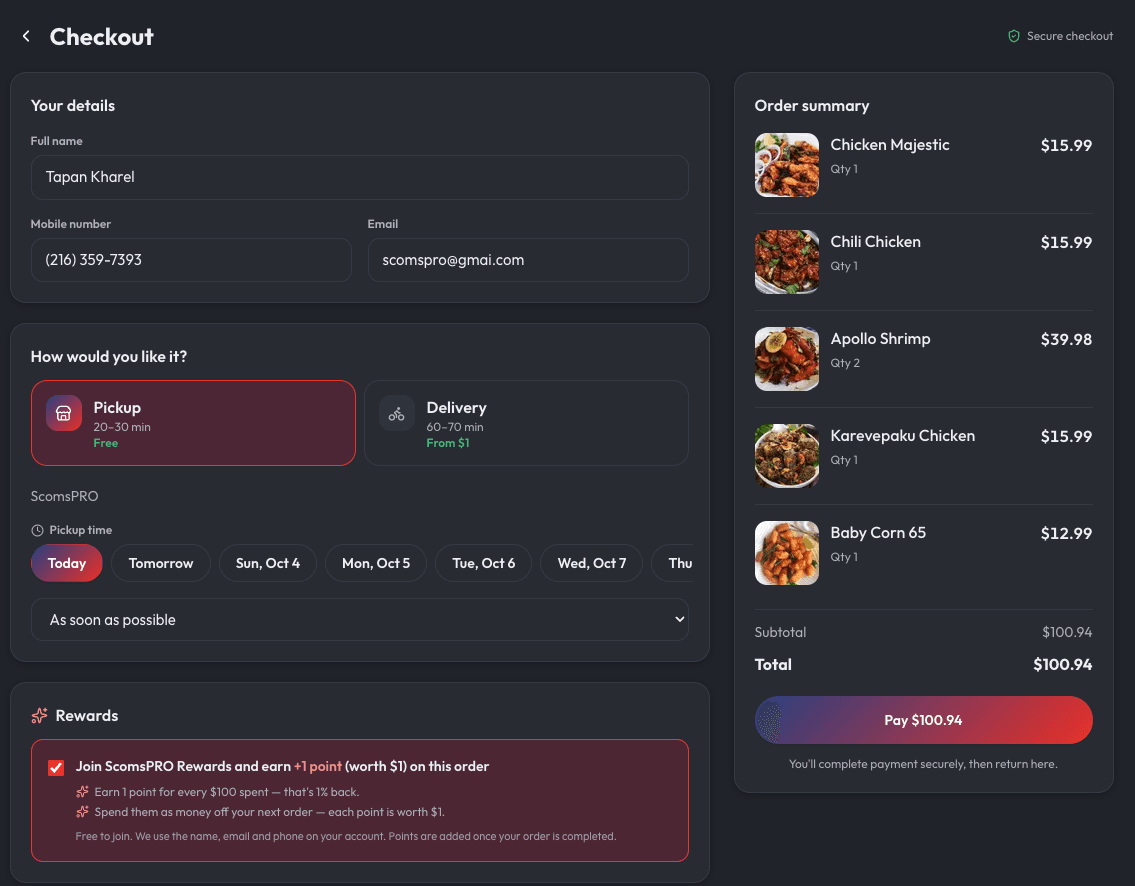
On your own site you pay a little more on that first order, and then that customer is on your list. You can send them a reward, a heads-up about a new dish or a slow-Tuesday offer, and none of it costs a commission. Our DoorDash fee breakdown goes through the plans in detail.
Why pickup on your own site is usually your best order
There's no driver to pay. The food gets eaten closer to how you made it, so you get fewer soggy-fries complaints and fewer refunds. The customer walks into your place, which means they see the dessert case, grab a drink from the fridge, or notice next week's lunch special. And you control the timing. With scheduled pickup, a 10am order for 12:15 gets cooked when the kitchen has room, not in the middle of the rush.
When delivery is worth it
Delivery reaches people who won't come to you: offices, families with little kids at home, and pretty much everyone when it's sleeting sideways in January. It's worth doing when orders are big enough to cover the driver, drives are short enough that food arrives hot, and your food holds up in a box.
Plenty of restaurants settle on a split. They deliver themselves within a tight radius through their own website, and leave the far-away customers to the apps, who probably wouldn't have found them otherwise.
If you run your own delivery
Set the rules so every trip pays for itself. Start with a small radius and only widen it if drive times stay short. Charge a delivery fee that covers a fair share of the driver's cost. Set a minimum order, because a single coffee shouldn't turn into a twenty-minute round trip. Think about a free-delivery threshold, something like free delivery over $50, which tends to get people adding a side or a dessert. And make sure checkout only accepts addresses you can actually reach.
Getting more people to choose pickup
Make pickup the default on your ordering page and delivery the option, not the other way round. Offer scheduled pickup so people can order lunch ahead. Give pickup orders a little something extra, like bonus loyalty points or a small discount, which still costs less than a driver. Make collecting painless, with a clearly labeled shelf by the door and a text when the order's ready, so people are in and out in a minute. Then say it wherever people decide where to eat: your Google profile, your social posts, and the card in every delivery-app bag.
So which should you push?
Pickup on your own website is almost always the most profitable online order you'll get, and app delivery is almost always the least. You don't need to turn either one down. Let the apps introduce you to new people, bring those people over to your own site, and give your regulars a good reason to come and collect.
NEAPES ordering websites let you set pickup and delivery your way (radius, fee, minimum order, free-delivery threshold), with scheduled orders, order-ready messages and loyalty points on every order, for $45 a month plus a 4% platform fee. See how it works, or plug your own numbers into the fee calculator.
Frequently asked questions
Is pickup or delivery more profitable for a restaurant?
Usually pickup. There's no driver to pay, the food arrives in better shape, and on your own website there's no app commission. Delivery through an app is typically the least profitable way to sell.
Should my restaurant do its own delivery?
It can pay off within a tight radius, with a delivery fee that covers part of the driver's cost, a minimum order, and food that travels well. Many restaurants deliver nearby themselves and leave far-away customers to the apps.
How do I get more customers to choose pickup?
Make pickup the default on your ordering page, offer scheduled pickup times, give pickup orders bonus points or a small discount, keep a labeled pickup shelf by the door, and text customers when the order's ready.
Do delivery apps take a commission on pickup orders too?
Often, yes, at a lower rate than delivery. DoorDash, for example, publishes a 6% commission on pickup orders in the US. Check the current terms for your plan and area.
Tagged: